
MONARCH MEMORY(H.K.)CO.,LIMITED
HOTLINE
8618770187778
When there is no cheaper and more efficient way to mass-produce terahertz emitters, laser etching is a good way to increase the output of gallium arsenide (GaAs). GaAs is a common semiconductor material used in these devices.
Researchers from the femtosecond spectroscopy department of Technology Graduate University said that the surface microstructure of GaAs films plays an important role in energy absorption and dissipation.
Pulsed etching materials with femtosecond laser creates microscopic grooves and ripples that enhance light absorption. After completing this step, the GaAs terahertz output will be enhanced by 65% if pumped by a sufficiently high-energy laser.
"Femtosecond laser etching allows us to design material properties and overcome their inherent limitations, such as directing to close to 100% photon absorption, wider absorption bandwidth, and electron concentration and lifecycle control," said researcher Julien Madéo. ”
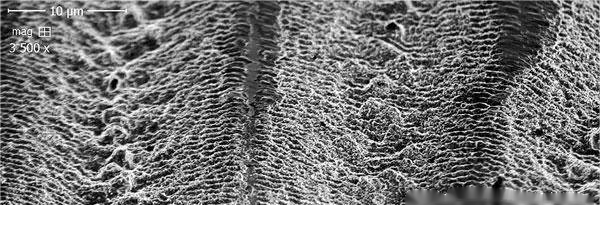
Femtosecond laser etching forms micro-grooves and ripples on the surface of GaAs films. The scale bar is 10 μm, and the magnification is 3500 times. Image source: OIST.
Etching technology enhances the output of the material despite reducing the photocurrent inside the substance. This counterintuitive phenomenon is caused by the fact that etched GaAs has a shorter charge carrier life cycle than unetched GaAs.
The terahertz region is located between infrared and microwaves within the electromagnetic spectrum and includes wavelengths from 0.1mm to 1mm. Excitation of terahertz waves is difficult because their frequencies are too high for a typical radio transmitter and too low for an optical transmitter.
One of the most commonly used terahertz emitters is called a light-guided antenna, which consists of two electrical contacts and a thin-film semiconductor (usually GaAs) between them. When the antenna is exposed to short laser pulses, in the semiconductor, photons excite electrons, and terahertz radiation short pulses are also generated. In this way, the energy of the laser beam is converted into terahertz waves.
Terahertz radiation is absorbed by water, and the use of terahertz devices over short distances to the Earth's atmosphere is limited. But terahertz radiation can penetrate fibers, paper, cardboard, plastic, wood, and ceramics. Many substances have a special "marker" in the terahertz band that makes it easy to identify with a terahertz scanner.
And, unlike X-rays and ultraviolet light, terahertz radiation is non-ionizing, making it safer to use on living tissues and DNA. Terahertz waves can also be used for communication, providing greater bandwidth than current microwaves.